


























































Medical Billing vs. Medical Coding: What’s the Difference?


Medical billing vs medical coding is a common source of confusion for people new to healthcare administration. The two functions are closely connected, but they are not the same job.
In simple terms, medical coding converts information from clinical documentation into standardized diagnosis and procedure codes, while medical billing uses information about healthcare services, including codes, to prepare and manage claims and the payment process. A medical coder focuses primarily on accurate code assignment; a medical biller focuses primarily on getting claims processed and payments properly handled. Although some organizations employ people who perform both functions, billing and coding involve different responsibilities, knowledge, and day-to-day tasks.
Understanding the difference can help healthcare practices, students, and anyone considering a career in healthcare administration understand how the revenue cycle works.
Medical Billing vs Medical Coding: The Basic Difference
The easiest way to understand billing vs coding is to look at their primary purpose.
| Medical Coding | Medical Billing |
| Translates clinical documentation into standardized codes | Uses claim information to support payment for healthcare services |
| Focuses on diagnoses, procedures, services, and documentation | Focuses on claims, payments, denials, patient balances, and payer communication |
| Reviews medical records and provider documentation | Reviews claim and insurance information |
| Assigns appropriate codes according to applicable guidelines | Submits claims and follows up on claim status |
| Supports accurate reporting and reimbursement | Helps the practice receive appropriate payment |
| Primarily documentation and coding focused | Primarily financial and claims-process focused |
These functions overlap because accurate coding is an important part of a clean healthcare claim. CMS explains that standardized code sets provide a common language for reporting diagnoses, procedures, services, equipment, and other healthcare items.
What Is Medical Coding?
Medical coding is the process of translating information documented in a patient’s healthcare record into standardized medical codes.
A medical coder may review documentation such as:
- Physician notes
- Diagnoses
- Procedures performed
- Laboratory or diagnostic services
- Treatment information
- Other documentation supporting the services provided
The coder then determines which applicable codes accurately represent the documented information.
Common Medical Coding Systems
Healthcare organizations use several standardized code sets.
ICD-10-CM is used to report diagnoses in healthcare settings. CMS notes that ICD-10-CM is maintained by the CDC’s National Center for Health Statistics.
ICD-10-PCS is used for inpatient hospital procedures.
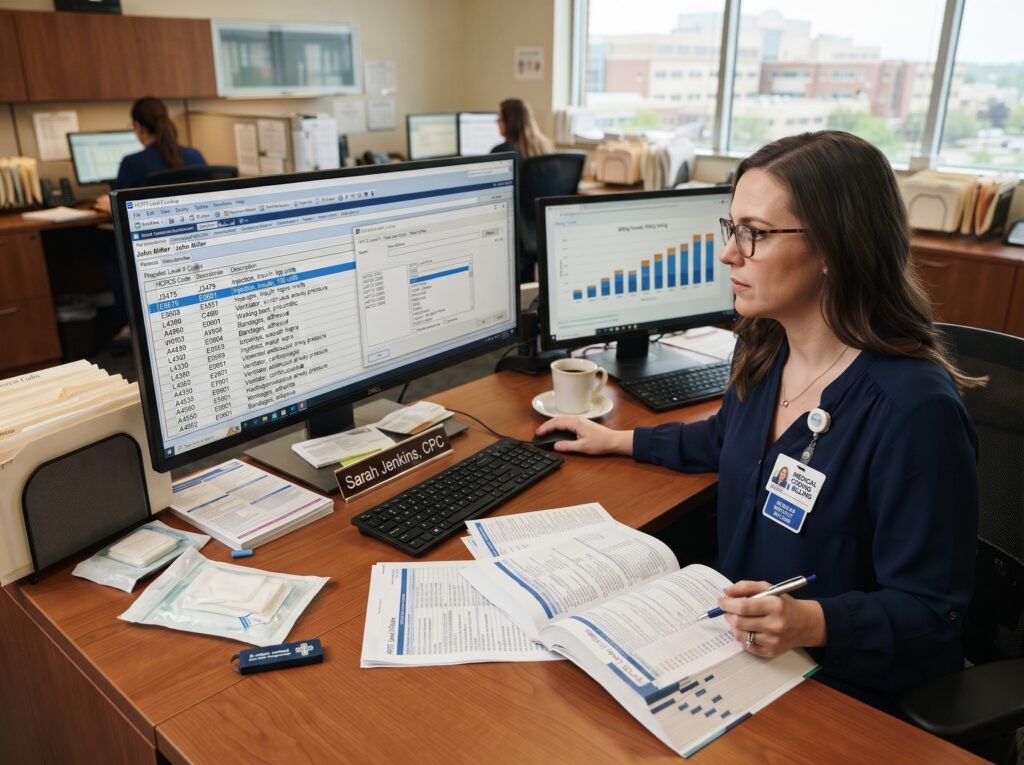
CPT, which is part of HCPCS Level I, is primarily used to identify healthcare services and procedures.
HCPCS Level II identifies certain products, supplies, drugs, equipment, and services that are not represented by CPT codes.
These systems have different purposes, and the applicable coding rules depend on the healthcare setting and claim.
What Does a Medical Coder Do?
A medical coder’s responsibilities can include:
- Reviewing clinical documentation.
- Identifying documented diagnoses and services.
- Selecting appropriate codes according to applicable coding guidelines.
- Checking documentation for completeness and consistency.
- Applying required coding conventions and rules.
- Communicating documentation or coding questions through appropriate channels.
- Staying current with code-set and guideline updates.
Accuracy matters because coding communicates important information about the services and conditions represented in healthcare records and claims.
A code itself, however, does not automatically guarantee insurance coverage or payment. CMS specifically notes that the existence of a code does not by itself establish coverage or reimbursement.
What Is Medical Billing?
Medical billing focuses on the financial and administrative side of healthcare claims. A medical biller works with information generated during the patient encounter and helps move a claim through the payment process.
Depending on the organization, billing responsibilities may include:
- Reviewing patient and insurance information
- Entering or reviewing charges
- Preparing claims
- Submitting claims to insurance payers
- Checking claim status
- Identifying claim problems
- Correcting appropriate claim errors
- Posting payments and adjustments
- Following up on outstanding balances
- Working with payer representatives
- Communicating with patients about applicable balances
AAPC describes medical billing as the process of translating healthcare services into bills or claims sent to insurers or patients and notes that billers may also work on claim corrections and follow-up. The exact responsibilities vary among medical practices, hospitals, billing companies, and other healthcare organizations.
How Medical Coding and Billing Work Together
Although billing vs coding describes two different functions, they are part of the same larger workflow.
Consider a simplified example.
A patient visits a healthcare provider for an evaluation.
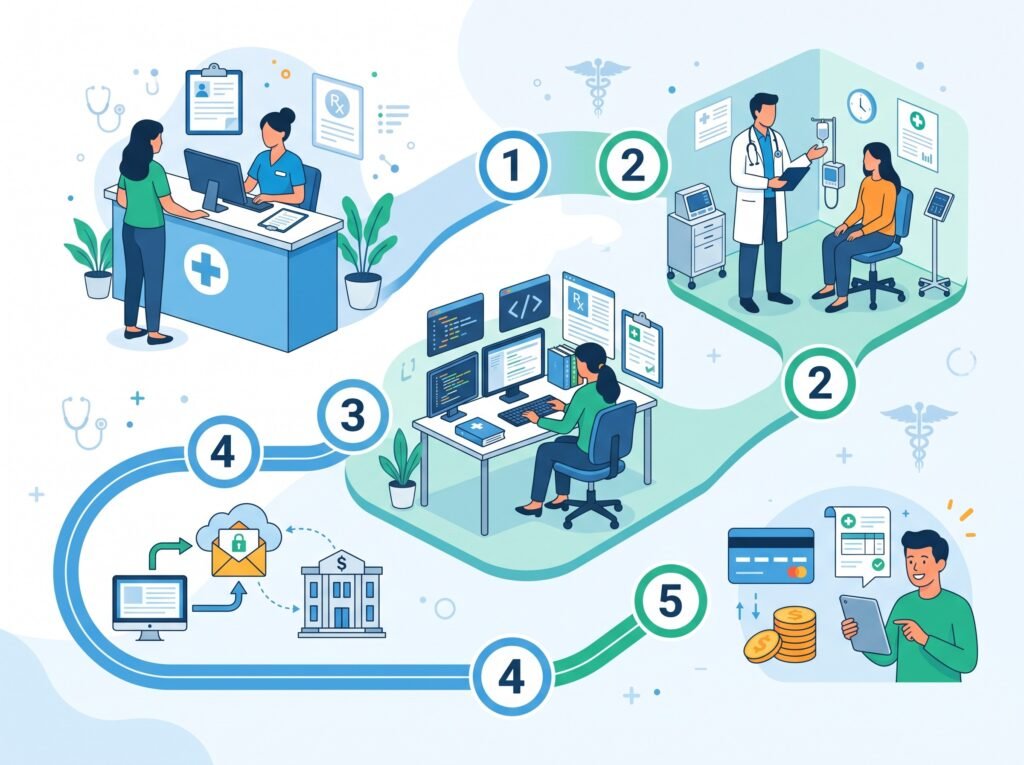
Step 1: The provider documents the encounter
The healthcare professional documents relevant information about the visit, including diagnoses, services, and procedures.
Step 2: The coder reviews the documentation
The medical coder analyzes the documentation and assigns the appropriate standardized codes according to applicable coding rules.
Step 3: The billing team prepares the claim
The billing process uses the relevant patient, provider, payer, charge, and coding information to prepare the claim.
Step 4: The claim is submitted
The claim is transmitted to the appropriate payer through the applicable claims process.
Step 5: The claim is processed
The payer evaluates the claim according to its applicable policies, contract terms, coverage rules, and other requirements.
Step 6: Payment or denial information is received
The practice receives information about payment, adjustment, denial, or other claim processing results.
Step 7: Follow-up occurs when necessary
If a claim requires correction, additional information, or follow-up, the appropriate staff investigate and take the next administrative step.
This illustrates why coding and billing must work together. A problem at one stage can create additional work later in the process.
Medical Coder vs. Medical Biller: Key Responsibilities
The difference becomes clearer when comparing typical responsibilities.
Medical Coder
A medical coder is generally focused on documentation and code accuracy.
Typical questions include:
- What diagnosis is documented?
- What procedure or service was performed?
- Which code accurately represents the documented service?
- Does the documentation support the selected code?
- Are there applicable coding guidelines that affect code selection?
Medical Biller
A medical biller is generally focused on claims and payment processes.
Typical questions include:
- Is the patient’s insurance information accurate?
- Has the claim been submitted?
- What is the claim’s current status?
- Was the claim paid or denied?
- Is additional information needed?
- Is a correction or follow-up appropriate?
- What payment or patient balance remains?
In some organizations, one employee may handle both sets of responsibilities. In larger organizations, the functions may be divided among specialized teams.
Why Accurate Coding Matters for Medical Billing
Accurate coding and complete documentation can support an effective claims process.
Standardized medical codes allow healthcare information to be communicated in a consistent format. CMS describes standardized coding systems as essential to orderly claims processing for Medicare and other health insurance programs.
Coding accuracy can also help reduce administrative problems associated with:
- Incorrect codes
- Missing information
- Documentation discrepancies
- Inappropriate code combinations
- Payer-specific claim requirements
- Outdated code information
However, coding should never be viewed as simply selecting a code that produces a particular payment. Codes should accurately reflect the documentation and applicable coding requirements.
Common Misunderstandings About Billing and Coding
“Billing and coding are the same thing.”
They are related but distinct functions. Coding primarily involves translating clinical information into standardized codes, while billing focuses on claims and payment-related processes.
“A medical coder decides what treatment a patient received.”
A coder should code based on appropriate documentation rather than independently deciding what treatment or diagnosis should have occurred.
“A code guarantees insurance payment.”
It does not. CMS states that the existence of a code does not automatically establish coverage or payment.
“Every medical practice has separate billing and coding departments.”
Not necessarily. Smaller practices may have staff members who perform multiple administrative functions, while larger organizations may use specialized coding, billing, compliance, and revenue-cycle teams.
Which Role Is More Involved in the Revenue Cycle?
Both roles contribute to the healthcare revenue cycle, but in different ways.
Coding provides standardized information about diagnoses and services. Billing uses that information as part of the claim and payment workflow.
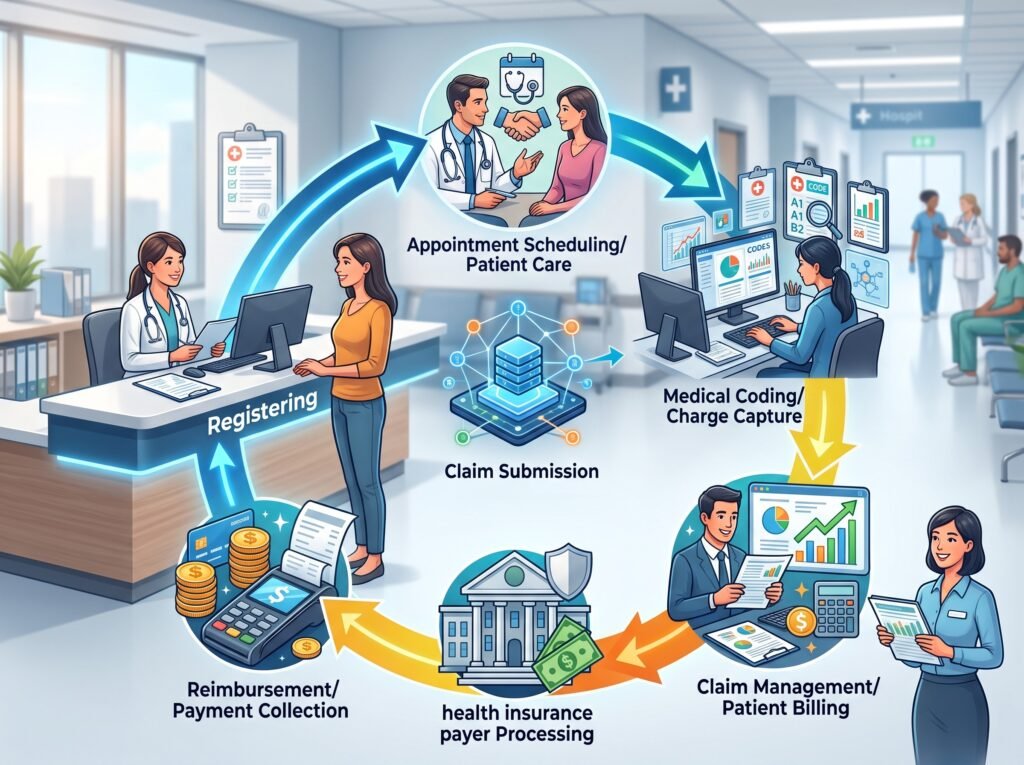
The broader revenue cycle can involve many additional activities, including:
- Patient registration
- Insurance verification
- Charge capture
- Coding
- Claim submission
- Payment posting
- Denial management
- Accounts receivable follow-up
- Patient billing
- Reporting and analysis
For this reason, effective revenue-cycle management generally requires coordination among multiple administrative functions.
Medical Billing vs Medical Coding as Career Paths
People interested in healthcare administration sometimes ask whether they should pursue billing or coding.
The answer depends on the type of work they want to perform.
Someone interested in documentation, medical terminology, anatomy, coding guidelines, and classification systems may be interested in medical coding.
Someone more interested in claims, payer communication, payment processing, accounts receivable, and administrative follow-up may prefer medical billing.
There is also overlap. Some professionals are trained to perform both billing and coding, while others specialize in one area.
Professional training and certification requirements can vary depending on the role, employer, healthcare setting, and credential being pursued. Anyone considering this as a career should review current requirements from recognized professional organizations and prospective employers.
How Healthcare Practices Can Improve Billing and Coding Coordination
Practices can strengthen coordination by establishing clear workflows and responsibilities.
Useful practices may include:
- Maintaining current coding resources and guidelines
- Providing appropriate staff training
- Keeping documentation standards clear
- Reviewing recurring claim problems
- Monitoring denial patterns
- Establishing communication between coding and billing teams
- Performing appropriate internal audits
- Protecting patient information
- Keeping payer requirements and organizational policies current
Because coding systems and requirements change over time, staff should rely on current official guidance rather than outdated code references. CMS currently publishes updated ICD-10-CM and ICD-10-PCS materials and maintains information about HCPCS code sets.
Frequently Asked Questions
1. What is the difference between medical billing and medical coding?
Medical coding converts documented healthcare information into standardized codes. Medical billing uses claim and patient information, including coding information, to submit and manage claims and support the payment process.
2. Is a medical coder the same as a medical biller?
No. A medical coder and medical biller have different primary responsibilities, although some employees and organizations combine the two roles.
3. Which comes first, medical billing or medical coding?
In a typical workflow, coding information is established from the clinical documentation before or as part of preparing the claim for billing. The exact workflow varies by organization and healthcare setting.
4. What codes do medical coders use?
Common code sets include ICD-10-CM for diagnoses, ICD-10-PCS for certain inpatient procedures, CPT for many professional and outpatient services, and HCPCS Level II for various products, supplies, drugs, equipment, and services. The appropriate code set depends on the service and setting.
5. Does accurate coding guarantee claim payment?
No. Accurate coding is important, but payment depends on applicable payer rules, coverage, documentation, eligibility, claim requirements, contracts, and other factors.
6. Can one person do both medical billing and coding?
Yes. Some healthcare organizations employ professionals who perform both functions, while other organizations have separate coding and billing teams.
7. Why are billing and coding important to a medical practice?
They help translate clinical services into standardized claim information and support the administrative process through which healthcare services are reported, claims are submitted, and payments are processed.
Conclusion
Understanding medical billing vs medical coding becomes much easier when their primary functions are separated. A medical coder focuses on translating clinical documentation into appropriate standardized codes, while a medical biller focuses on claims and payment-related processes. The two roles are different, but they depend on one another. Accurate coding provides essential information for claims, while effective billing helps move those claims through the payment process. Together, they form important components of the healthcare revenue cycle.
For healthcare organizations, clear workflows, qualified staff, current coding resources, accurate documentation, and ongoing communication can help support effective billing and coding operations.


How Does the Medical Billing Process Work? Complete Guide
22nd Sep 2026[…] Medical Billing vs. Medical Coding: What’s the Difference? […]