




























































How to Communicate With Someone Who Has Alzheimer’s


Communicating with someone who has Alzheimer’s can become more difficult as the disease affects memory, language, attention, and the ability to process information. However, meaningful communication remains possible. The goal is not always to get the “right” answer or complete a conversation exactly as you would with someone without dementia. Instead, effective communicate with someone who has Alzheimer’s strategies focus on patience, respect, simple language, active listening, and reassurance.
A person with Alzheimer’s may struggle to find a word, lose track of a conversation, repeat a question, or misunderstand what someone is saying. These changes are symptoms of the disease, not intentional behavior. Adjusting the way you communicate can make everyday interactions less frustrating for both the person and the caregiver. This guide explains practical Alzheimer’s communication and dementia communication techniques that families and caregivers can use at home.
Why Does Alzheimer’s Affect Communication?
Alzheimer’s disease can affect more than memory. As the condition progresses, a person may have difficulty finding words, understanding language, organizing thoughts, following lengthy conversations, or filtering out background noise.
Communication changes can include:
- Trouble finding the right word
- Forgetting what they were saying
- Difficulty understanding complicated questions
- Repeating words, questions, or stories
- Losing track of a conversation
- Taking longer to respond
- Becoming frustrated when they cannot express themselves
- Having difficulty following conversations involving several people
- Becoming confused by background sounds or multiple distractions
These changes vary from person to person and can change over time.
Understanding this can help caregivers respond with patience rather than assuming the person is being difficult or deliberately refusing to communicate.
How to Communicate with someone who has Alzheimer’s
The most helpful approach is usually simple, calm, respectful, and patient. Give the person enough time to understand what you have said and respond in their own way.
Here are practical strategies that can improve everyday conversations.
1. Get Their Attention First
Before beginning an important conversation, make sure the person is paying attention.
Move into their field of vision, make comfortable eye contact, and use their name. Avoid starting a conversation while standing in another room or while the television or radio is loud.
For example, instead of calling from another room:
“Mom, do you want to go somewhere?”
Try approaching her first and saying:
“Mom, I’d like to talk with you about going to the doctor.”
This gives the person context before you ask a question.
2. Speak Clearly and Use Short Sentences
Long explanations can become difficult to follow.
Try to communicate one idea at a time. Use familiar words and avoid unnecessarily complicated instructions.
Instead of:
“After breakfast, could you get dressed because we need to leave for your appointment in about an hour?”
Try:
“Let’s get dressed. We have a doctor’s appointment.”
If more information is needed, provide it one step at a time.
3. Give Extra Time to Respond
One of the most important caregiver tips is to avoid rushing the person.
Someone with Alzheimer’s may need additional time to understand a question and formulate an answer. If you immediately repeat the question or answer for them, you may unintentionally increase pressure.
After asking a question, pause and give the person time.
A quiet pause may feel uncomfortable to the caregiver, but it can give the person an opportunity to participate in the conversation.
4. Ask Simple Questions
Open-ended questions can sometimes be difficult for a person with Alzheimer’s.
Instead of asking:
“What would you like for lunch?”
You might offer two choices:
“Would you like soup or a sandwich?”
For some situations, a yes-or-no question may be easier:
“Would you like some tea?”
Simple choices can help the person participate without being overwhelmed by too many options.
5. Listen Without Interrupting
Try to listen to the entire message rather than focusing only on whether the words are correct.
The person may take longer to find a word or explain an idea. Interrupting can make it harder for them to finish.
Pay attention to:
- Facial expressions
- Tone of voice
- Gestures
- Body language
- Changes in mood
- What they may be trying to communicate through actions
Communication is not limited to spoken words.
What Not to Do During Alzheimer’s Communication
Knowing what to avoid can be just as useful as knowing what to do.
Avoid Arguing
If a person with Alzheimer’s says something that is incorrect, correcting them repeatedly may lead to frustration without improving understanding.
For example, if someone insists that they need to go to work even though they retired years ago, repeatedly saying, “You don’t work anymore; you’re retired,” may not resolve the situation.
Instead, acknowledge the underlying feeling and consider gently redirecting the conversation.
You might say:
“You’re thinking about work today. What did you enjoy most about your job?”
The appropriate response depends on the situation and the person’s emotional state.
Don’t Quiz Their Memory
Questions such as:
- “Do you remember who I am?”
- “What did we do yesterday?”
- “What is my name?”
- “Don’t you remember?”
can make the person feel tested or embarrassed.
If they forget someone’s name, introduce the person naturally rather than turning the moment into a memory test.
Don’t Talk About Them as If They Aren’t There
A person with Alzheimer’s should remain part of conversations about their life and care whenever possible.
Even when communication becomes difficult, speak directly to the person and allow them to participate in decisions to the extent they can.
This preserves dignity and recognizes that they are still an individual with preferences, feelings, and relationships.
Avoid a Harsh or Frustrated Tone
People often respond to more than words. Facial expressions, posture, volume, and tone can affect how a message is received.
An impatient or angry tone may increase distress.
Try to maintain a calm, respectful, matter-of-fact manner, particularly when a conversation becomes challenging.
Create a Better Environment for Conversation
The environment can make communication easier or harder.
A noisy room with a television playing, several people talking, and other distractions can make it difficult for someone with Alzheimer’s to focus.
Before an important conversation:
- Reduce unnecessary background noise.
- Turn down or switch off the television.
- Move to a quieter room if appropriate.
- Face the person while speaking.
- Make sure the lighting is comfortable.
- Avoid having several people ask questions at once.
- Give the person your full attention.
A calmer environment can make it easier to understand both spoken words and nonverbal communication.
Use Nonverbal Communication
As verbal communication becomes more difficult, gestures, facial expressions, photographs, and other visual cues may become useful.
For example, if you’re talking about lunch, showing a picture or pointing toward the kitchen may provide additional context.
A person’s body language can also communicate important information. Watch for signs of discomfort, fear, frustration, tiredness, or confusion.
Physical contact, such as holding a person’s hand, may be reassuring for some people, but it should never be assumed to be welcome. Pay attention to their response and personal boundaries.
When Someone Repeats the Same Question
Repetition is common in Alzheimer’s disease.
A person may ask:
“When are we leaving?”
and ask again a few minutes later.
It can be frustrating for caregivers, especially when the same question has already been answered. However, repeatedly saying “I already told you” may increase distress.
Instead, calmly answer again or provide a visual reminder when appropriate.
For example, a simple written note saying:
Doctor appointment — 2:00 PM
may help in some situations.
If repetition is accompanied by new distress or a noticeable change in behavior, consider whether something else may be contributing, such as discomfort, hunger, thirst, fatigue, environmental stress, or another health issue.
What to Do When the Person Becomes Frustrated
Communication difficulties can be frustrating for someone who knows what they want to say but cannot find the words.
If the person becomes upset:
- Stay calm.
- Lower the amount of information you’re giving.
- Pause the conversation if necessary.
- Acknowledge their feelings.
- Reduce environmental distractions.
- Try rephrasing rather than repeating the same sentence.
- Consider redirecting attention to a familiar activity.
Sometimes the most helpful response is simply to slow down and give the person space.
Use Familiar Memories and Activities
Conversation does not always have to revolve around current events or recent memories.
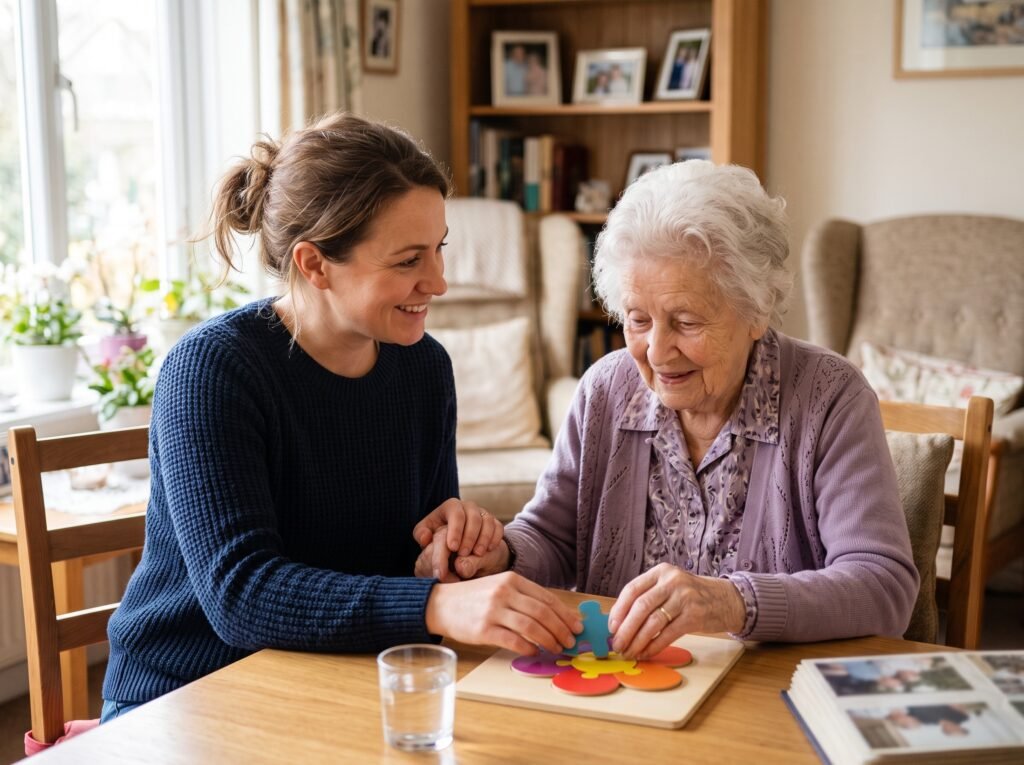
Familiar music, photographs, hobbies, recipes, objects, and stories from earlier life may provide useful conversation prompts.
For example, looking through an old photo album may create opportunities to talk about:
- Family members
- Places the person has lived
- Previous jobs
- Favorite activities
- Holidays
- Music
- Childhood memories
The purpose is not to test whether the person remembers every detail. It is to create an opportunity for connection.
Communicating During Personal Care
Some of the most difficult communication situations occur during bathing, dressing, medication routines, or other personal-care activities.
Before beginning, explain what you are doing in simple language.
For example:
“It’s time to get dressed.”
Then give one step at a time rather than providing several instructions at once.
Respect privacy and dignity. If the person becomes distressed, pause when possible and consider whether the timing, environment, discomfort, or communication approach may be contributing.
For complex care needs, caregivers should work with the person’s healthcare team for appropriate guidance.
When Communication Changes Suddenly
Alzheimer’s communication difficulties generally develop as part of the disease, but a sudden or rapidly changing behavior or communication problem should not automatically be attributed to Alzheimer’s.
Sudden confusion or major changes can sometimes be associated with another medical problem, infection, medication changes, pain, dehydration, or other causes.
Contact a qualified healthcare professional promptly if there is a sudden or significant change in the person’s usual behavior or communication, particularly when accompanied by other concerning symptoms.
How Caregivers Can Make Communication Easier
Good communication is not about finding a perfect phrase every time. It is about adapting to the person’s changing abilities.
A useful daily approach is:
| Situation | Helpful approach |
| Person can’t find a word | Give them time and avoid immediately finishing every sentence |
| Person doesn’t understand | Rephrase using simpler words |
| Person repeats a question | Respond calmly and consider a visual reminder |
| Person becomes frustrated | Pause, reassure, and reduce distractions |
| Too many choices cause confusion | Offer one or two simple options |
| Person says something inaccurate | Avoid unnecessary arguing or correcting |
| Conversation becomes difficult | Use gestures, photos, familiar objects, or activities |
| Several people are talking | Reduce background conversation and distractions |
When to Seek Professional Support
Caregivers do not have to manage communication challenges alone.
Consider discussing persistent or worsening communication difficulties with a healthcare professional, particularly when changes interfere with eating, medication management, personal care, safety, or the person’s ability to express pain or other health concerns. A healthcare professional can also help determine whether a sudden communication or behavior change may have another medical cause.
Speech-language professionals may be able to provide additional strategies for communication difficulties in dementia, depending on the person’s needs and local services.
Frequently Asked Questions
1. What is the best way to communicate with someone who has Alzheimer’s?
Use a calm and respectful tone, make eye contact, speak clearly, use short sentences, and give the person enough time to respond. Simple questions and limited choices may also make conversations easier.
2. Should I correct someone with Alzheimer’s when they are wrong?
Not necessarily. Correcting every mistake can create frustration. If the information is not important for safety or another immediate concern, acknowledging the person’s feelings and gently redirecting the conversation may be more helpful.
3. Why does someone with Alzheimer’s repeat the same questions?
Repetition can occur because Alzheimer’s affects memory and communication. The person may not remember that they already asked the question or may be seeking reassurance. Responding calmly and using reminders may help.
4. Should I use yes-or-no questions with someone who has Alzheimer’s?
Yes-or-no questions can be helpful when open-ended questions are difficult. You can also offer two simple choices, such as “Would you like tea or water?” The best approach depends on the person’s abilities and the situation.
5. What should I do if the person becomes angry during a conversation?
Remain calm, avoid arguing, reduce distractions, and give the person space if appropriate. Try to understand what may be causing the distress and consider redirecting their attention. If aggressive or concerning behavior is new or severe, contact a healthcare professional.
6. Can a person with Alzheimer’s still communicate effectively?
Yes. Communication abilities vary considerably between people and can change as Alzheimer’s progresses. Even when speaking becomes difficult, people may continue communicating through facial expressions, gestures, tone, touch, and other forms of nonverbal communication.
7. When should a caregiver seek medical advice about communication changes?
Seek professional advice when communication changes are sudden, significantly different from the person’s usual pattern, or interfere with safety or basic care. Sudden changes may have causes other than Alzheimer’s that need medical evaluation.
Conclusion
Effective communicating with Alzheimer’s patient strategies are based on patience, respect, flexibility, and understanding. Alzheimer’s communication can become more challenging as the disease progresses, but caregivers can often make conversations easier by using simple language, allowing extra response time, minimizing distractions, and paying attention to nonverbal cues.
Good dementia communication is not about forcing someone to remember or correcting every mistake. It is about maintaining connection and dignity while adapting to changing abilities. With practical caregiver tips, supportive communication techniques, and professional guidance when needed, families can create more comfortable and meaningful interactions with a person living with Alzheimer’s.