




























































What Is Revenue Cycle Management (RCM) in Healthcare?


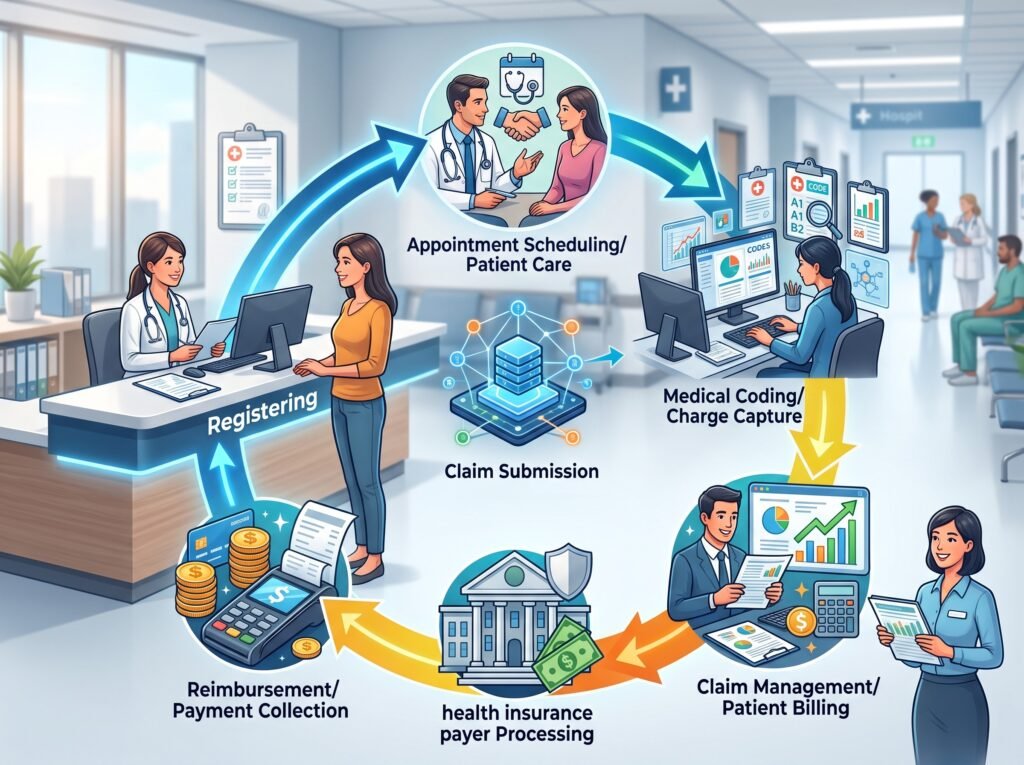
Revenue cycle management (RCM) is the process healthcare organizations use to manage the financial side of patient care, from scheduling and insurance verification through medical billing, claim submission, payment posting, and patient collections. In simple terms, it helps a healthcare practice make sure it is appropriately paid for the services it provides.
A strong healthcare RCM process connects administrative, clinical, coding, billing, and financial activities into one continuous workflow. When information is incomplete or inaccurate at one stage, the problem can affect later stages of the revenue cycle, potentially causing claim rejections, denials, delayed payments, or patient billing issues.
The American Medical Association describes RCM as covering activities from initial patient registration through payment collection. Its framework generally divides the process into front-end, mid-cycle, and back-end activities.
What Is Revenue Cycle Management in Healthcare?
Revenue cycle management is the coordinated process of managing healthcare revenue throughout a patient’s financial journey with a medical practice or healthcare organization.
The RCM process typically includes:
- Patient registration
- Insurance eligibility and benefits verification
- Patient check-in and check-out
- Documentation and charge capture
- Medical coding
- Claim preparation and submission
- Claim status monitoring
- Payment posting and reconciliation
- Denial management
- Patient billing and collections
These activities can be grouped into three broad stages:
| RCM stage | Common activities |
| Front end | Registration, scheduling, insurance verification, authorization, check-in |
| Mid cycle | Documentation, charge capture, coding, billing, claim preparation |
| Back end | Claim follow-up, payment posting, denials, patient statements, collections |
The exact workflow can vary depending on the specialty, payer mix, organization, and payment model.
Why Is Healthcare RCM Important?
Healthcare organizations must manage both patient care and the financial processes that support their operations.
An effective RCM system can help practices:
- Submit more complete and accurate claims
- Identify insurance problems earlier
- Reduce avoidable billing errors
- Track unpaid or rejected claims
- Manage denials systematically
- Post payments accurately
- Monitor accounts receivable
- Communicate patient financial responsibility
- Improve administrative efficiency
RCM also affects the patient experience. Insurance information, eligibility, copayments, deductibles, statements, and payment responsibilities can be confusing. Clear processes can help reduce avoidable billing confusion.
The AMA recommends monitoring the revenue cycle as an integrated process rather than treating registration, clinical documentation, coding, and billing as completely separate functions.
How Does the Revenue Cycle Management Process Work?
The RCM process begins before a patient receives care and continues until the healthcare organization receives and reconciles payment.
1. Patient Scheduling and Registration
The process often starts when an appointment is scheduled.
The practice collects and verifies information such as:
- Patient name
- Date of birth
- Contact information
- Insurance information
- Policy or member identification details
- Referring provider information when applicable
- Other information required for the encounter
Accurate information at this stage matters because incorrect demographic or insurance data can create problems later in the billing process.
The AMA recommends verifying and updating patient information before appointments to reduce errors that can affect the revenue cycle.
2. Insurance Eligibility and Benefits Verification
Before providing services, the practice may verify whether the patient’s insurance is active and determine relevant benefits and financial responsibilities.
Depending on the situation, verification may include checking:
- Eligibility status
- Network participation
- Covered services
- Copayment requirements
- Deductible information
- Coinsurance
- Prior authorization requirements
- Referral requirements
Eligibility verification is an important front-end RCM activity because discovering an insurance problem after care has already been provided can make billing more complicated.
3. Prior Authorization and Referrals
Some services require prior authorization or a referral depending on the patient’s insurance plan and the service being provided.
The practice should identify applicable requirements before the service whenever possible.
Missing authorization or referral requirements can contribute to claim problems and delayed reimbursement.
4. Patient Check-In and Check-Out
At check-in, staff confirm patient information and complete other administrative requirements.
At check-out, the practice may:
- Confirm services provided
- Schedule follow-up appointments
- Collect applicable patient responsibility
- Confirm referral or authorization information
- Ensure the encounter is ready for documentation and billing
Good communication between front-desk, clinical, and billing staff is important because information collected during the encounter can affect later stages of the revenue cycle.
5. Documentation and Charge Capture
After the patient receives care, the services provided need to be documented appropriately.
Charge capture connects the services documented during an encounter with the billing process.
Missing charges can result in services being provided without corresponding claims, while inaccurate charges can create billing and compliance concerns.
Clinical documentation should accurately support the services reported.
6. Medical Coding
Medical coding translates documented diagnoses, procedures, and services into standardized codes used for billing and reporting.
Depending on the service, coding may involve systems such as:
- ICD-10-CM
- CPT
- HCPCS
Coding must be supported by appropriate documentation and follow applicable coding and payer requirements.
Coding errors can contribute to claim rejections, denials, payment delays, or the need for corrections.
7. Claim Preparation and Submission
Once documentation, coding, and billing information are ready, the claim is prepared and submitted to the appropriate payer.
In the United States, HIPAA-adopted electronic healthcare claim standards include the ASC X12N 837 transaction for institutional, professional, and dental healthcare claims.
A claim may pass through a clearinghouse before reaching the payer. Depending on the workflow, automated checks may identify missing or inconsistent information before submission.
The goal is to submit a complete, accurate claim supported by the documentation and coding.
8. Claim Adjudication and Payment
After receiving a claim, the payer processes it according to applicable coverage and payment rules.
The payer may:
- Pay the claim
- Partially pay the claim
- Reject the claim
- Deny the claim
- Request additional information
A claim rejection and a claim denial are not always the same.
A rejection generally means a claim could not be processed as submitted because of an issue that may need correction. A denial occurs when the payer processes the claim but determines that payment will not be made under the applicable circumstances.
Understanding the reason for the payer response is essential for appropriate follow-up.
9. Payment Posting and Reconciliation
When payment information is received, the practice posts payments and adjustments to the appropriate patient and account records.
Electronic remittance information can help explain how the payer processed a claim, including payment amounts and patient responsibility.
Healthcare organizations should reconcile posted payments with payer remittance information and internal account records.
This helps identify discrepancies and keeps financial records accurate.
10. Denial Management and A/R Follow-Up
Not every claim is paid on the first submission.
The billing team may need to investigate:
- Claim denials
- Claim rejections
- Underpayments
- Unpaid claims
- Missing information
- Authorization problems
- Coding issues
- Eligibility problems
Denial management should not simply focus on resubmitting individual claims. Practices can also analyze denial patterns to identify recurring problems in the RCM process.
For example, if many claims are denied because of eligibility problems, the organization may need to review its front-end verification workflow.
The AMA recommends monitoring payer decisions and accounts receivable rather than allowing unpaid claims to remain unnoticed.
What Is the Difference Between RCM and Medical Billing?
Medical billing is an important component of revenue cycle management, but the two terms are not interchangeable.
Medical billing primarily focuses on preparing, submitting, tracking, and managing claims and payments related to healthcare services.
RCM is broader. It includes the financial workflow before, during, and after billing.
For example:
| Medical billing | Revenue cycle management |
| Claim preparation | Patient registration |
| Claim submission | Insurance verification |
| Claim follow-up | Authorization workflows |
| Payment posting | Documentation and charge capture |
| Denial follow-up | Coding and billing |
| Patient statements | Claims management |
| Collections | Payment and A/R management |
In other words, medical billing is one part of the larger revenue cycle.
Common Revenue Cycle Management Challenges
Healthcare organizations can experience RCM problems at multiple points.
Inaccurate Patient Information
Incorrect demographic or insurance information can result in eligibility problems or claim errors.
Eligibility and Authorization Issues
If coverage or authorization requirements are not identified early, the claim may encounter payment problems later.
Coding and Documentation Errors
Coding that does not accurately reflect the documented services can contribute to claim problems and compliance concerns.
Claim Rejections and Denials
Unresolved claim issues can delay reimbursement and increase administrative work.
Slow A/R Follow-Up
When unpaid claims are not monitored consistently, outstanding balances can remain unresolved.
Patient Payment Challenges
Patients may not understand their financial responsibility or may have difficulty navigating bills and insurance explanations.
Poor Communication Between Departments
RCM involves multiple teams. If front-desk, clinical, coding, and billing staff work in disconnected workflows, problems may not be identified until later in the cycle.
How Can Practices Improve Revenue Cycle Management?
Improving healthcare RCM does not necessarily mean adding more administrative steps. Often, the goal is to make existing workflows more accurate, consistent, and measurable.
Verify Information Early
Confirm patient demographics and insurance information before the encounter whenever possible.
Standardize Workflows
Create clear procedures for registration, eligibility verification, authorization, coding, claims, denials, and payment posting.
Monitor Key RCM Metrics
Useful measures may include:
- Accounts receivable days
- Clean claim or first-pass resolution rates
- Claim denial rates
- Days in A/R
- Payment turnaround
- Outstanding claim volume
- Patient collection performance
Metrics should be interpreted within the context of the practice’s specialty, payer mix, contracts, and billing model rather than treated as universal benchmarks.
Analyze Denial Trends
Instead of treating every denial as an isolated event, group denials by reason.
For example:
Eligibility issue → review insurance verification.
Coding issue → review coding and documentation workflows.
Authorization issue → examine referral and authorization procedures.
This approach can help organizations identify process-level problems.
Use Appropriate Technology
Practice management systems, electronic eligibility checks, electronic claims, electronic remittance advice, automated work queues, and reporting tools can support RCM workflows.
However, technology does not replace appropriate processes, trained staff, or oversight. The AMA notes that selecting an appropriate practice management system is an important part of automating administrative and billing functions.
Is RCM Only Important for Large Hospitals?
No.
Revenue cycle management is relevant to many healthcare organizations, including:
- Physician practices
- Specialty clinics
- Hospitals
- Ambulatory surgery centers
- Outpatient facilities
- Medical groups
- Diagnostic organizations
- Other healthcare providers that bill insurance
The specific RCM workflow varies by organization.
A small physician practice may have a relatively simple billing structure, while a large health system may manage multiple specialties, facilities, payers, and payment models.
In-House vs. Outsourced Revenue Cycle Management
Healthcare organizations may manage RCM internally, outsource some functions, or use a combination of both.
In-House RCM
The organization’s own employees handle activities such as billing, coding, claims, denials, and collections.
Potential advantages include direct oversight and integration with internal workflows.
Outsourced RCM
An external RCM company manages some or all revenue-cycle functions on behalf of the healthcare organization.
Potential considerations include:
- Vendor experience
- Specialty knowledge
- Technology
- Reporting capabilities
- Security and compliance practices
- Communication processes
- Contract terms
- Performance monitoring
The appropriate approach depends on the organization’s size, staffing, specialty, financial goals, technology, and operational requirements.
Frequently Asked Questions About Revenue Cycle Management
1. What is revenue cycle management in healthcare?
Revenue cycle management is the process of managing the financial activities associated with patient care, from registration and insurance verification through coding, claims, payment posting, denials, and collections.
2. What are the main steps in the RCM process?
Common steps include patient registration, insurance verification, authorization, check-in and check-out, documentation, coding, claim submission, payer processing, payment posting, denial management, patient billing, and collections.
3. Why is revenue cycle management important?
Effective RCM helps healthcare organizations manage reimbursement, identify billing problems, monitor outstanding claims, improve administrative workflows, and manage patient financial responsibilities.
4. What is the difference between RCM and medical billing?
Medical billing is one component of RCM. RCM covers a broader financial workflow that begins before the patient encounter and continues through claims, reimbursement, patient payments, and accounts receivable management.
5. What causes revenue cycle problems?
Common causes include inaccurate patient information, eligibility issues, authorization problems, coding or documentation errors, claim rejections, denials, slow follow-up, and communication gaps between departments.
6. Can technology improve healthcare RCM?
Technology can automate or streamline tasks such as eligibility verification, claims submission, payment processing, reporting, and workflow management. However, technology works best when supported by accurate data, appropriate processes, trained personnel, and ongoing oversight.
7. Should a medical practice outsource revenue cycle management?
There is no single answer for every practice. Organizations may compare in-house and outsourced models based on staffing, specialty complexity, technology, costs, reporting, compliance requirements, and the level of operational control they need.
Conclusion
Revenue cycle management is much broader than submitting medical claims. It is an interconnected process that begins with patient registration and insurance verification and continues through documentation, coding, claim submission, payer processing, payment posting, denial management, and collections. A well-organized healthcare RCM process can help practices identify problems earlier, manage outstanding claims, maintain accurate financial records, and create clearer workflows for both staff and patients. The most effective approach is usually one that connects front-end, mid-cycle, and back-end activities instead of treating each function as an isolated task.
Understanding the complete revenue cycle gives healthcare organizations a clearer view of where billing problems originate and where workflow improvements may be possible. Regular monitoring, accurate information, appropriate technology, and communication among teams can all contribute to a more consistent RCM process.