




























































What Is Medical Billing? A Complete Beginner’s Guide


If you have ever visited a doctor, received a medical service, or looked at a healthcare invoice, you have probably encountered medical billing—even if you did not realize it. Medical billing is the administrative process used to communicate healthcare services to insurance companies and other payers, request payment, process claims, and determine what portion of a covered service may remain the patient’s responsibility.
For healthcare providers, medical billing is an essential part of the revenue cycle. It connects the clinical side of healthcare with the financial side, helping practices receive payment for the services they provide.
In simple terms, medical billing takes information about a patient’s healthcare services and turns it into a claim that can be submitted to an insurance company or other payer for reimbursement.
This beginner’s guide explains medical billing, the medical billing process, common medical codes, the role of medical billers, and what happens when a claim is accepted, rejected, or denied.
What Is Medical Billing?
Medical billing is the process of preparing, submitting, tracking, and following up on healthcare claims so providers can receive payment for services delivered to patients.
A medical biller works with information such as:
- Patient demographics and insurance details
- Provider information
- Dates of service
- Diagnoses
- Medical procedures and services
- Procedure and diagnosis codes
- Insurance claim information
- Payments and adjustments
- Patient responsibility
A claim is essentially a request for payment. CMS describes a healthcare claim as information submitted by a healthcare provider to a health plan to request payment for healthcare services.
Medical billing is closely connected to medical coding, but the two are not exactly the same.
Medical Billing vs. Medical Coding
Medical coding involves translating clinical documentation about diagnoses, procedures, and services into standardized codes. Medical billing uses coded information, along with other administrative and insurance information, to prepare and manage claims.
For example, diagnosis coding commonly uses ICD-10-CM, while procedure and service coding may involve CPT and HCPCS codes. CMS identifies ICD-10-CM as the diagnosis code set used across healthcare settings, while HCPCS includes standardized systems for reporting healthcare services, products, and supplies.
| Medical Coding | Medical Billing |
| Converts clinical information into standardized codes | Uses coded and administrative information to create claims |
| Focuses on diagnoses, procedures, and services | Focuses on claim submission, payment, and account follow-up |
| Requires knowledge of coding guidelines | Requires knowledge of payer and billing requirements |
| Supports accurate claims | Helps providers receive appropriate reimbursement |
In many healthcare organizations, coding and billing work closely together as part of the overall revenue cycle.
Why Is Medical Billing Important?
Healthcare providers need a reliable financial process to collect payment for the services they provide. Without effective billing, even a busy medical practice can experience delayed payments, rejected claims, unresolved balances, and administrative challenges.
An effective medical billing operation helps practices:
- Submit complete and accurate claims
- Communicate healthcare services to payers
- Track claim status
- Identify rejected or denied claims
- Post insurance payments and adjustments
- Follow up on outstanding balances
- Determine patient responsibility
- Maintain organized financial records
Electronic transactions are an important part of modern healthcare billing. CMS explains that electronic data interchange allows healthcare information to be transferred between providers, payers, clearinghouses, and other organizations using standardized formats.
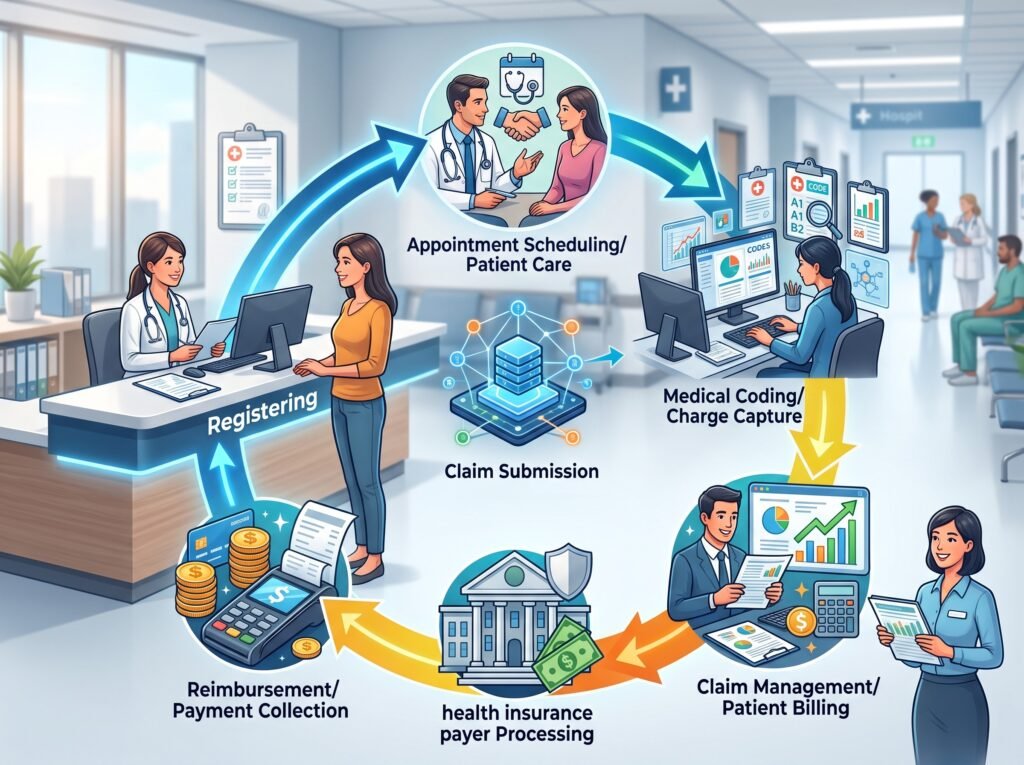
The Medical Billing Process: Step by Step
The medical billing process can vary depending on the provider, payer, specialty, and type of service. However, the general workflow follows several important stages.
1. Patient Registration
The process begins when a patient schedules an appointment or receives healthcare services.
The practice collects information such as:
- Patient name and contact details
- Date of birth
- Insurance information
- Subscriber information
- Policy or member identification details
- Relevant demographic information
Accurate information at registration is important because errors can create problems later in the claim process.
2. Insurance Eligibility Verification
Before providing certain services, the healthcare organization may verify the patient’s insurance eligibility and benefits.
This can help the practice understand whether the patient’s coverage is active and identify relevant benefit information.
Eligibility verification does not necessarily guarantee that a particular service will ultimately be covered. Coverage can depend on the patient’s plan, medical policy, authorization requirements, coding, and other factors.
3. Documentation and Medical Coding
After a healthcare service is provided, clinical documentation is reviewed for coding purposes.
Common coding systems include:
- ICD-10-CM: Used to report diagnoses.
- CPT: A standardized system for reporting many physician and other professional healthcare services and procedures.
- HCPCS Level II: Used for certain products, supplies, services, and items not represented by CPT codes.
CMS notes that CPT is maintained by the American Medical Association and is used to identify many medical services and procedures billed to public and private health insurance programs.
The correct code selection depends on the documentation, applicable coding guidelines, and the specific service provided.
4. Charge Entry and Claim Preparation
The coded information and other billing details are entered into the practice’s billing system.
A claim may contain information about:
- The healthcare provider
- The patient
- The payer
- Diagnosis codes
- Procedure or service codes
- Dates of service
- Charges
- Other required claim information
The objective is to submit the information required by the applicable payer and claim standard.
5. Claim Submission
The completed claim is submitted to the appropriate payer, often electronically.
For Medicare, for example, CMS explains that electronic claims can be transmitted to a Medicare Administrative Contractor (MAC) using software that meets applicable requirements. Claims undergo various edits before being processed.
In many workflows, a clearinghouse may serve as an intermediary between the healthcare provider and payer.
6. Claim Processing and Adjudication
After submission, the payer processes the claim.
The payer may determine:
- Whether the claim contains required information
- Whether the service is covered under the applicable plan
- The allowed amount
- The amount payable by the payer
- The patient’s financial responsibility
- Whether adjustments or other actions apply
A claim can be paid, partially paid, rejected, or denied depending on the circumstances.
7. Payment Posting
Once the payer processes a claim, payment information is recorded in the provider’s billing system.
CMS explains that electronic remittance advice can provide claim-level information about payment and adjustments, including reasons for adjustments.
Payment posting may involve recording:
- Insurance payments
- Contractual adjustments
- Patient responsibility
- Other adjustments
- Remaining balances
8. Denial Management and Claim Follow-Up
Not every claim is paid on the first submission.
Claims may be rejected or denied for various administrative, coding, coverage, or documentation-related reasons. A billing team reviews the available information, identifies the issue, and determines whether the claim can be corrected, resubmitted, or appealed.
This makes denial management an important part of the revenue cycle.
9. Patient Billing
After insurance processing, any remaining amount that is legitimately the patient’s responsibility may be billed to the patient.
A patient’s responsibility can include amounts such as deductibles, copayments, or coinsurance, depending on their insurance plan and the services received.
CMS recommends that patients compare their medical bill with their Explanation of Benefits (EOB) and check that the services and amounts are consistent.
Common Medical Billing Terms Beginners Should Know
Understanding basic terminology makes medical billing explained much easier.
Claim
A request for payment submitted to a health plan for healthcare services.
Payer
An organization responsible for processing and paying eligible healthcare claims, such as an insurance company or government health program.
Clearinghouse
An intermediary that can help healthcare organizations exchange standardized electronic transactions with payers.
Rejection
A claim that is not accepted for processing, often because required information or formatting is incorrect. A rejected claim may need correction and resubmission.
Denial
A claim or claim line that has been processed but is not paid as submitted. The reason for the denial should be reviewed to determine the appropriate next step.
Explanation of Benefits (EOB)
A document from a health plan explaining how a healthcare claim was processed, including information about allowed amounts, insurance payments, and potential patient responsibility. An EOB is not itself a medical bill.
Remittance Advice
Information from a payer explaining payment and adjustments associated with submitted claims. CMS describes electronic remittance advice as containing adjudication and payment information.
What Is the Difference Between a Medical Bill and a Medical Claim?
These terms are sometimes confused.
A medical claim is generally submitted by a healthcare provider to a payer to request payment for healthcare services.
A medical bill is generally the statement a provider sends to a patient showing an amount the patient may owe after considering applicable insurance payments and adjustments.
For insured patients, an EOB can help explain how the health plan processed the claim before or around the time a provider bill is received. CMS specifically advises patients to compare the provider bill with the EOB.
Who Handles Medical Billing?
Depending on the size and structure of a healthcare organization, billing may be handled by:
- In-house medical billers
- Medical coders
- Billing managers
- Revenue cycle management teams
- Healthcare administrative staff
- Third-party medical billing companies
Some practices outsource all or part of their billing operations to specialized medical billing service providers.
Outsourcing can be particularly relevant for practices that want dedicated administrative support while allowing their clinical teams to focus primarily on patient care.
Common Challenges in Medical Billing
Medical billing can be complex because healthcare organizations must work with changing payer requirements, coding rules, patient information, claim standards, and payment policies.
Common challenges include:
- Incorrect patient or insurance information
- Coding errors
- Missing claim information
- Eligibility issues
- Authorization requirements
- Timely filing concerns
- Claim rejections
- Claim denials
- Underpayments or incorrect adjustments
- Unresolved patient balances
Because healthcare billing rules can vary by payer and change over time, billing teams need processes for staying current with applicable requirements.
CMS maintains current information on coding systems, electronic claims, billing transactions, and Medicare billing requirements.
How Medical Billing Supports the Healthcare Revenue Cycle
Medical billing is one part of the broader revenue cycle management (RCM) process.
A healthcare revenue cycle can involve activities before, during, and after a patient encounter, including:
- Scheduling and registration
- Insurance eligibility verification
- Authorization when applicable
- Documentation and coding
- Charge capture
- Claim creation
- Claim submission
- Payment posting
- Denial management
- Patient billing and collections
Each stage can affect the financial outcome of a healthcare encounter.
Accurate information and effective communication between clinical, coding, billing, and administrative teams can therefore be important for maintaining an organized revenue cycle.
How Patients Can Better Understand Their Medical Bills
Medical billing is primarily a provider-side administrative function, but patients can also take steps to understand their healthcare bills.
When reviewing a bill, check:
- Your name and personal information
- Provider or facility name
- Dates of service
- Services listed
- Insurance payment information
- Adjustments
- Amount shown as patient responsibility
CMS recommends reviewing medical bills for errors and comparing them with the corresponding EOB when applicable.
If something does not appear correct, contact the provider’s billing department or your health plan for clarification. For questions about your medical condition or treatment, speak with an appropriately qualified healthcare professional rather than relying on billing documents for medical advice.
Frequently Asked Questions About Medical Billing
1. What is medical billing in simple terms?
Medical billing is the process of preparing and submitting healthcare claims to insurance companies or other payers and managing those claims through payment, adjustments, denials, and patient responsibility.
2. Is medical billing the same as medical coding?
No. Medical coding converts clinical information into standardized diagnosis and procedure codes, while medical billing uses coded information and other claim data to request payment and manage the financial side of healthcare services.
3. What codes are used in medical billing?
Common coding systems include ICD-10-CM for diagnoses and CPT and HCPCS for many procedures, services, products, and supplies. The appropriate code depends on the service, documentation, coding guidelines, and applicable requirements.
4. What happens after a medical claim is submitted?
The payer reviews and processes the claim. It may be paid, partially paid, rejected, or denied. Payment and adjustment information is then communicated to the provider through applicable payment or remittance processes.
5. Why are medical claims denied?
Claims can be denied for different reasons, including coverage issues, coding problems, missing or incorrect information, authorization requirements, or other payer-specific requirements. The exact reason should be reviewed on the payer’s response before determining the appropriate next action.
6. What is an Explanation of Benefits?
An Explanation of Benefits, or EOB, is a document from a health plan that explains how a healthcare claim was processed. It can show services, allowed amounts, insurance payments, and amounts that may be the patient’s responsibility. An EOB is different from a provider’s medical bill.
7. Can medical billing be outsourced?
Yes. Healthcare practices can use third-party medical billing companies to handle some or all of their billing and revenue cycle activities. The appropriate arrangement depends on the practice’s needs, specialty, payer mix, internal resources, and operational requirements.
Conclusion
Understanding medical billing becomes much easier when you view it as a process that connects healthcare services with payment. From patient registration and insurance verification to coding, claim submission, payment posting, denial management, and patient billing, each stage contributes to the overall revenue cycle.
For healthcare providers, accurate and organized billing can support efficient administrative operations and help claims move through the payment process appropriately. For patients, understanding claims, bills, EOBs, and patient responsibility can make healthcare costs easier to review.
Whether billing is handled internally or through a specialized service provider, staying current with applicable coding, payer, and billing requirements is essential. For more healthcare revenue cycle resources, explore the related D-Med articles below.