




























































10 Practical Tips for Alzheimer’s Caregivers


Alzheimer’s Caregivers can be rewarding, but it can also become physically and emotionally demanding as the disease progresses. Knowing what to do during everyday situations—such as repeated questions, changes in behavior, difficulty with bathing, or problems with routines—can make caregiving more manageable.
These Alzheimer’s caregiver tips focus on practical strategies that families can use at home. The most important principles are to keep routines predictable, communicate with patience, encourage safe independence, make the environment safer, monitor changes in health and behavior, and ask for help when caregiving becomes difficult to manage alone.
There is no single approach that works for every person with Alzheimer’s. Care should be adapted to the individual’s abilities, preferences, stage of disease, medical needs, and safety concerns.
1. Establish a Simple, Predictable Routine
People with Alzheimer’s may find changes in routine confusing or stressful. A predictable schedule can make everyday activities easier to understand and anticipate.
Try to keep important activities around similar times each day, such as:
- Waking and going to bed
- Meals and snacks
- Bathing and dressing
- Medication routines
- Physical activity
- Appointments
- Rest periods
A routine does not need to be rigid. Unexpected events will happen, and flexibility is important. The goal is to create familiar patterns rather than a strict timetable.
NIA recommends maintaining routines for activities such as eating, bathing, and dressing because familiar patterns can help make daily life more comfortable.
A simple daily structure
| Time | Possible Activity |
| Morning | Breakfast, personal care, prescribed medications |
| Late morning | Walk, hobby, music, or household activity |
| Afternoon | Lunch, rest, family visit, or activity |
| Late afternoon | Light activity or social interaction |
| Evening | Dinner, relaxing activity, personal care, bedtime routine |
Adjust the schedule according to the person’s preferences and energy level.
2. Use Simple, Respectful Communication
Communication difficulties are common as Alzheimer’s progresses. A person may struggle to find words, remember information, understand complicated questions, or express what they need.
One of the most useful dementia caregiver tips is to slow down communication rather than trying to get the person to respond faster.
Try to:
- Make eye contact when appropriate.
- Use the person’s name.
- Speak calmly and clearly.
- Use short sentences.
- Ask one question at a time.
- Allow extra time for an answer.
- Offer simple choices.
- Rephrase something if the person does not understand.
- Listen to concerns without immediately correcting them.
For example, instead of asking, “What would you like to drink?” you could ask, “Would you like tea or water?”
NIA specifically recommends allowing extra response time, using simple questions, and avoiding interruptions or arguments.
Avoid turning conversations into memory tests
Repeatedly asking questions such as “Do you remember?” can create frustration. If the person cannot remember something, provide gentle assistance instead of emphasizing the memory failure.
The goal is communication and connection—not testing how much the person remembers.
3. Encourage Independence When It Is Safe
Alzheimer’s disease can gradually affect the ability to complete everyday activities, but people may continue to perform many tasks with appropriate support.
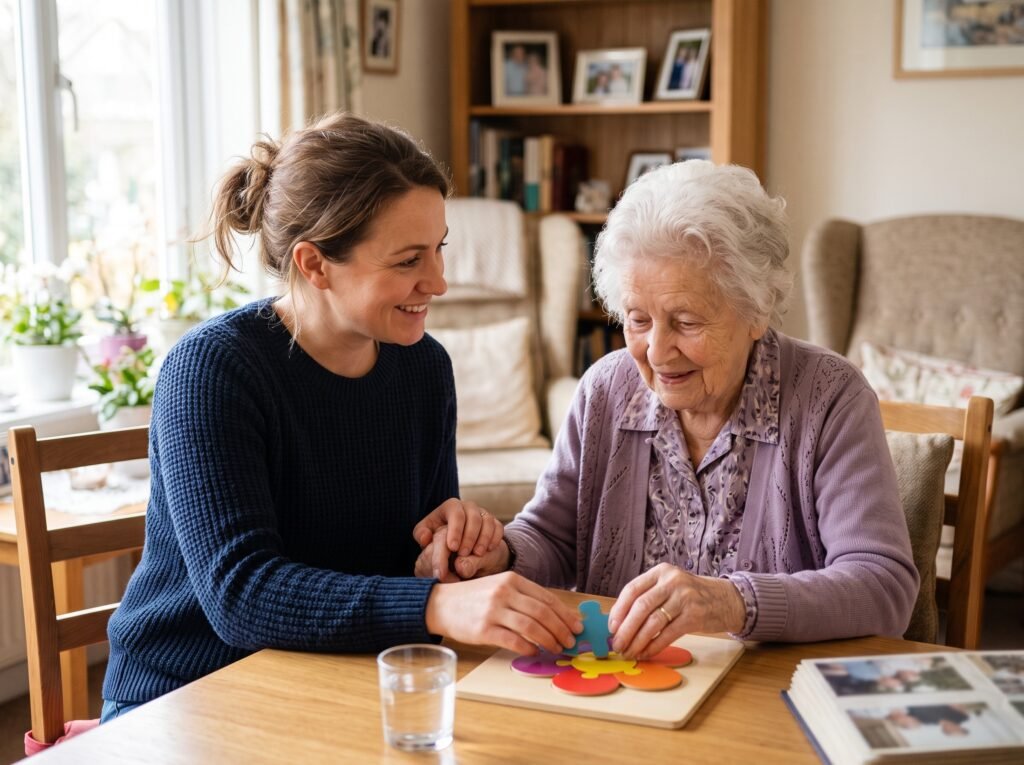
Whenever safe, allow the person to participate rather than doing everything for them.
For example, they might be able to:
- Fold towels
- Set the table
- Water plants
- Sort laundry
- Help prepare simple foods
- Choose between two outfits
- Look through family photographs
- Listen to familiar music
- Participate in a favorite hobby
Break complicated activities into smaller steps.
If the person becomes frustrated, simplify the activity or provide more assistance.
NIA recommends matching activities to the person’s abilities, helping them get started, and watching for frustration. Activities are more useful when the person feels successful rather than overwhelmed.
4. Make the Home Safer
Home safety becomes increasingly important as Alzheimer’s affects memory, judgment, balance, or awareness of hazards.
Walk through the home and consider possible risks.
Depending on the person’s needs, you may need to:
- Remove clutter from walkways.
- Improve lighting.
- Reduce trip hazards.
- Secure medications.
- Store cleaning products and other potentially dangerous items safely.
- Consider bathroom safety equipment.
- Secure unsafe areas when appropriate.
- Keep emergency contact information accessible.
- Review whether driving remains safe.
Wandering can also become a concern. If a person is at risk of getting lost, discuss appropriate safety measures with healthcare professionals.
NIA recommends securing dangerous household items and ensuring that a person who may wander has identification or another way to provide contact information.
Safety planning should be individualized. Measures that are appropriate for one household may not be necessary or suitable for another.
5. Look for the Reason Behind Difficult Behaviors
One of the more challenging aspects of Alzheimer’s care is responding to changes in behavior.
A person may become:
- Agitated
- Restless
- Suspicious
- Anxious
- Withdrawn
- Aggressive
- Repetitive
- Confused
Instead of immediately treating the behavior as simply a symptom of dementia, consider whether something else could be contributing.
Possible factors include:
- Pain
- Hunger or thirst
- Constipation
- Illness or infection
- Medication side effects
- Fatigue
- Too much noise
- An unfamiliar environment
- Changes in routine
NIA notes that sudden or rapidly changing behavior—particularly when associated with infection or a recent medication change—should be brought to a doctor’s attention promptly.
Keep a behavior log
If a behavior repeatedly occurs, record:
- What happened
- Time of day
- What happened immediately beforehand
- How the person responded
- What seemed to calm the situation
Patterns may become easier to identify, and this information can be useful when discussing the situation with a healthcare professional.
6. Avoid Arguing When the Person Is Confused
Trying to prove that someone is wrong may not resolve confusion and can increase distress.
For example, a person with Alzheimer’s may insist that they need to go somewhere even though they are already there. Repeatedly explaining the facts may not help.
Instead:
- Stay calm.
- Acknowledge the person’s feelings.
- Reassure them.
- Avoid arguing.
- Redirect their attention when appropriate.
You might respond with reassurance and then suggest a familiar activity, such as looking through photographs, listening to music, or having a snack.
CDC guidance similarly encourages caregivers to meet the person where they are rather than repeatedly correcting them about time, place, or other details.
This does not mean ignoring safety concerns. If confusion creates an immediate safety risk, appropriate intervention and professional guidance are important.
7. Make Mealtimes Comfortable
Eating can become challenging as Alzheimer’s progresses. A person may forget to eat, lose interest in food, become distracted, or have difficulty using utensils.
Simple environmental changes may help.
Try to:
- Serve meals at a consistent time and location.
- Offer familiar foods the person enjoys.
- Reduce television and background noise.
- Keep the eating area comfortable.
- Avoid rushing.
- Offer manageable portions.
- Make food easy to see and handle.
- Allow enough time for eating.
NIA recommends familiar foods and consistent mealtime routines and suggests reducing distractions such as television or radio.
Changes in eating, swallowing, weight, or hydration should be discussed with a healthcare professional, particularly if they persist.
8. Adapt Personal Care With Patience
Bathing, dressing, grooming, and toileting can become difficult because the person may not understand what is happening, may feel embarrassed, or may find the activity uncomfortable.
Give simple explanations before beginning.
For example, rather than suddenly starting a bath, explain each step calmly and allow the person time to respond.
Helpful approaches can include:
- Preparing everything before starting.
- Keeping the room comfortably warm.
- Offering simple choices.
- Allowing the person to do whatever parts of the task they can manage.
- Using towels or clothing to preserve privacy.
- Avoiding rushing.
- Stopping and trying again later if the person becomes very distressed.
NIA recommends preparing bathing supplies in advance, explaining each step, maintaining safety, and never leaving someone with Alzheimer’s alone in a bathtub or shower.
If personal care becomes too difficult or unsafe for one caregiver to manage, ask about professional assistance.
9. Create a Care Plan and Keep Important Information Organized
Caregiving often involves more than daily personal care. Families may need to coordinate medical appointments, medications, healthcare providers, insurance information, emergency contacts, and future care decisions.
A written care plan can help keep information organized.
Consider recording:
- Medical conditions
- Current medications
- Allergies
- Healthcare provider contacts
- Appointment dates
- Important symptoms or behavior changes
- Emergency contacts
- Daily routines
- Food preferences
- Safety concerns
- Care responsibilities among family members
CDC recommends maintaining and updating a care plan, particularly when the person’s health or medications change.
Keep sensitive health information secure and share it only with people who need it for caregiving or healthcare purposes.
10. Make Alzheimer’s Caregivers Support Part of the Plan
Perhaps the most important of these Alzheimer’s caregiver tips is not trying to do everything alone.
Caregiving can affect sleep, physical health, emotional well-being, work, relationships, and finances. CDC reports that caregivers of people with Alzheimer’s disease and related dementias can face greater risks of anxiety, depression, and reduced quality of life.
Caregiver support may come from:
- Family members
- Friends
- Respite-care services
- Home-care professionals
- Support groups
- Social workers
- Community organizations
- Healthcare professionals
- Counseling services
Be specific when asking family and friends for help.
Instead of saying, “I need more help,” try:
- “Can you stay with Mom for two hours on Saturday?”
- “Can you take Dad to his appointment?”
- “Could you prepare dinner twice this week?”
- “Can you handle the pharmacy pickup?”
Specific requests make it easier for others to contribute.
Watch for signs that you need more support
Consider asking for additional help if you are:
- Constantly exhausted
- Missing your own medical appointments
- Unable to sleep regularly
- Becoming increasingly isolated
- Feeling overwhelmed most days
- Having difficulty managing medications or appointments
- Unable to safely provide the required level of care
Taking care of yourself is not separate from Alzheimer’s care. A caregiver who has appropriate support is better positioned to provide consistent care.
When Should an Alzheimer’s Caregiver Contact a Healthcare Professional?
Caregivers should contact a healthcare professional when there is a significant change in the person’s condition or behavior.
Examples include:
- Sudden or rapidly worsening confusion
- New aggression or agitation
- A fall or injury
- Significant changes in eating or drinking
- New difficulty walking
- Medication side effects or concerns
- New incontinence or a substantial change in toileting
- Difficulty swallowing
- Persistent pain
- Signs of infection
- Repeated wandering or safety concerns
Sudden changes should not automatically be attributed to Alzheimer’s. Medical problems, pain, medication effects, dehydration, constipation, or infection can sometimes contribute to behavioral changes.
Seek urgent medical attention for emergencies such as serious injury, severe breathing problems, loss of consciousness, or other immediately dangerous symptoms.
A Practical Alzheimer’s Caregiver Checklist
For beginners, it can help to focus on a few fundamentals each day:
Daily priorities:
- Keep the routine familiar.
- Communicate calmly.
- Encourage safe independence.
- Offer meaningful activities.
- Make meals comfortable.
- Monitor changes in behavior or health.
- Keep the environment safe.
- Record important health information.
- Accept help from others.
- Protect your own health and rest.
You do not need to implement every strategy at once. Start with the challenges that are affecting daily life most.
Frequently Asked Questions
1. What are the most useful Alzheimer’s caregiver tips for beginners?
Start with a predictable routine, simple communication, a safe environment, meaningful activities, and organized health information. Just as importantly, build a support network rather than trying to manage every responsibility alone.
2. How should I communicate with someone who has Alzheimer’s?
Speak calmly, use short sentences, ask one question at a time, allow extra time for responses, and avoid arguing. Simple yes-or-no choices can sometimes make communication easier.
3. Should I correct someone with Alzheimer’s when they are confused?
Not necessarily. If correcting a harmless misunderstanding is likely to increase distress, acknowledging the person’s feelings and redirecting the conversation may be more helpful. Safety-related situations require a different response.
4. What should I do if someone with Alzheimer’s becomes aggressive?
Remain calm, avoid arguing, reduce stimulation, and consider possible causes such as pain, illness, medication effects, hunger, thirst, or an unfamiliar environment. New or rapidly worsening aggression should be discussed with a healthcare professional.
5. How can caregivers avoid burnout?
Share responsibilities, accept respite care when available, maintain your own healthcare, stay connected with supportive people, and seek professional or peer support when needed. Caregiver self-care is an important part of sustainable Alzheimer’s care.
6. What activities are appropriate for someone with Alzheimer’s?
Activities should match the person’s abilities and interests. Walking, music, gardening, simple household tasks, cooking activities, photographs, crafts, and social visits may be appropriate depending on the person’s abilities and safety.
7. When should an Alzheimer’s caregiver seek professional help?
Professional assistance may be appropriate when daily care becomes unsafe or too difficult to manage, the person’s needs increase substantially, or caregiving is seriously affecting the caregiver’s health. A healthcare professional or care coordinator can help identify suitable support options.
Conclusion
The best Alzheimer’s caregiver tips are often practical rather than complicated: maintain familiar routines, communicate patiently, encourage safe independence, adapt activities, respond calmly to difficult behaviors, and make the home environment safer. At the same time, effective Alzheimer’s care requires recognizing when a problem may have a medical cause and when additional support is necessary. Sudden behavioral or health changes deserve professional attention rather than being automatically blamed on dementia.
Finally, remember that caregiver support is part of the care plan. Accepting help, taking breaks, maintaining your own health, and planning for changing needs can make caregiving more sustainable for both the caregiver and the person receiving care.
There is no perfect way to provide dementia care. The goal is to create a safe, respectful, flexible approach that responds to the person’s changing needs while protecting the caregiver’s well-being.


Early Signs of Alzheimer’s Disease: 10 Symptoms Families Should Know
22nd Sep 2026[…] 10 Practical Tips for Alzheimer’s Caregivers […]