



























































CPT Codes Explained: A Beginner’s Guide


If you are new to medical billing and coding, CPT codes can seem confusing at first. You may see five-digit codes on medical claims, billing records, or healthcare documentation and wonder what they actually mean.
CPT codes are standardized codes used to describe medical services and procedures performed by physicians and other qualified healthcare professionals. They help healthcare providers, payers, and other organizations communicate consistently about the services delivered to a patient.
CPT stands for Current Procedural Terminology. The CPT code set is maintained by the American Medical Association (AMA) and is widely used in the United States to report medical, surgical, diagnostic, laboratory, evaluation and management, and other healthcare services.
It is important to remember that CPT codes describe what was done, while diagnosis codes such as ICD-10-CM generally describe why the service was provided.
What Are CPT Codes?
CPT codes are five-digit codes that represent medical services and procedures.
They provide a standardized way to describe healthcare services without relying entirely on lengthy written descriptions.
For example, a healthcare encounter might involve:
- An office or outpatient evaluation
- A diagnostic test
- A surgical procedure
- A laboratory service
- An imaging service
- A preventive service
- A therapeutic procedure
- An evaluation and management (E/M) service
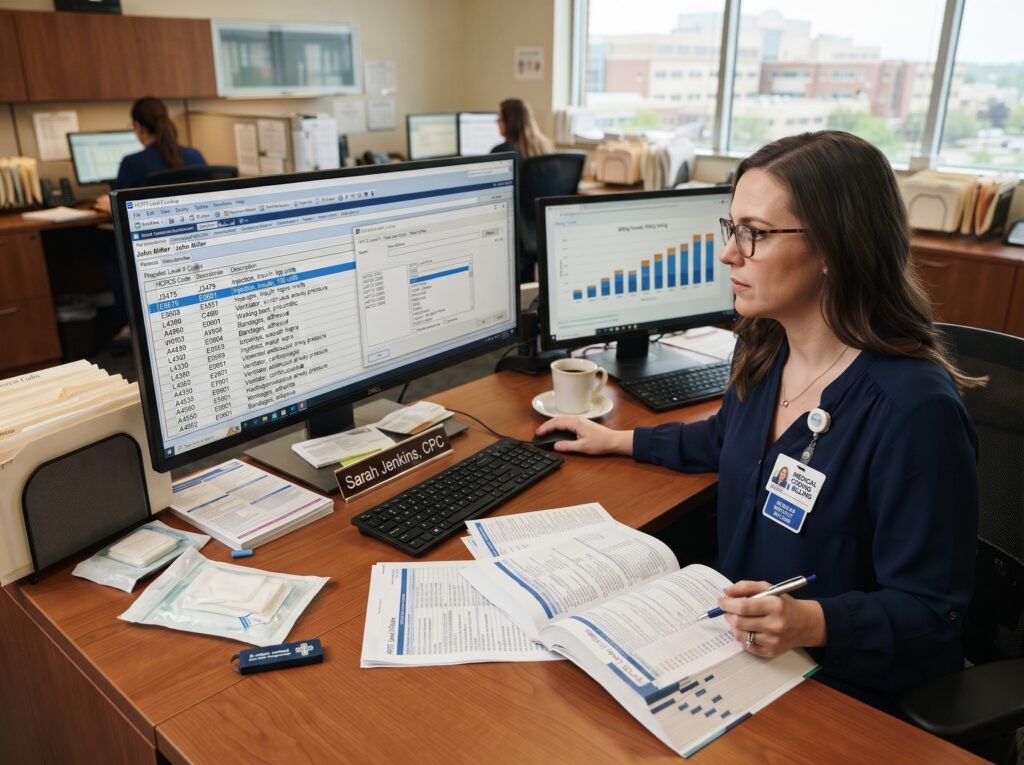
A coder reviews the documentation and determines which CPT code or codes accurately represent the services supported by the medical record.
The code is then used as part of the broader billing and claims process.
Why Are CPT Codes Important?
Without standardized procedure codes, healthcare organizations would have greater difficulty communicating consistently about services.
CPT coding helps support:
- Consistent reporting of medical services
- Insurance claim processing
- Healthcare documentation
- Communication between providers and payers
- Data collection and analysis
- Payment and reimbursement processes
- Healthcare quality reporting and administration
However, assigning a CPT code is not simply a matter of finding a code that sounds similar to the service. Coders must follow the applicable code description, guidelines, documentation requirements, and payer rules.
How Does CPT Coding Work?
A simplified CPT coding workflow looks like this:
Patient receives care → Provider documents the service → Coder reviews documentation → Appropriate CPT code is selected → Claim is submitted → Payer processes the claim
The medical record is particularly important because the code should be supported by the documented service.
A coder may need to consider details such as:
- What service was performed?
- Why was it performed?
- How extensive was the service?
- What body area or system was involved?
- Was the service performed separately or as part of another procedure?
- Does the CPT code have specific reporting requirements?
- Are modifiers appropriate?
- Does the documentation support the selected code?
Accurate coding therefore depends on both coding knowledge and complete clinical documentation.
Types of CPT Codes
CPT codes are organized into different categories. Understanding these categories makes CPT coding easier to learn.
Category I CPT Codes
Category I codes describe established medical procedures and services.
They cover a broad range of healthcare activities, including evaluation and management, surgery, anesthesia, radiology, pathology and laboratory services, and medicine.
These are the CPT codes most people encounter when discussing routine medical billing and procedure coding.
Category II CPT Codes
Category II codes are supplemental tracking codes used primarily for performance measurement.
They can help collect information about quality-of-care measures and are generally not used in the same way as Category I codes for reporting procedures for payment.
Category III CPT Codes
Category III codes are temporary codes used to identify emerging technologies, procedures, and services.
They provide a way to report and track newer services while evidence and clinical experience continue to develop.
Proprietary Laboratory Analyses (PLA) Codes
PLA codes describe certain proprietary clinical laboratory analyses.
These codes are part of the CPT code set and address specific laboratory tests that meet the applicable criteria.
CPT Codes vs. ICD-10-CM Codes
One of the most important concepts for beginners is understanding the difference between procedure codes and diagnosis codes.
CPT codes generally describe the service or procedure that was performed.
ICD-10-CM codes generally describe the patient’s diagnosis, condition, symptom, or reason for the service.
| CPT Codes | ICD-10-CM Codes |
| Describe medical services and procedures | Describe diagnoses and health conditions |
| Answer: “What was done?” | Generally answer: “Why was it done?” |
| Used for procedure/service reporting | Used for diagnosis reporting |
| Maintained by the AMA | ICD-10-CM is maintained in the U.S. through the CDC/NCHS with federal coordination |
| Commonly five-digit CPT codes | ICD-10-CM codes can contain letters and numbers and vary in length |
For example, if a patient visits a healthcare professional because of a medical condition, the claim may contain an ICD-10-CM diagnosis code explaining the reason for care and a CPT code describing the service provided.
Both types of coding can work together within the healthcare billing process.
CPT Codes vs. HCPCS Codes
Another common source of confusion is the relationship between CPT and HCPCS.
HCPCS stands for Healthcare Common Procedure Coding System.
HCPCS has two primary levels:
- Level I: CPT codes maintained by the AMA
- Level II: Codes maintained by CMS that identify products, supplies, and certain services not included in CPT
HCPCS Level II codes are commonly used for items and services such as certain durable medical equipment, ambulance services, prosthetics, orthotics, and supplies.
This means that CPT is part of the broader HCPCS system.
For beginners, a simple way to remember the distinction is:
CPT = medical services and procedures
HCPCS Level II = many supplies, products, and services outside the CPT code set
How Do Medical Coders Choose the Right CPT Code?
Selecting the correct CPT code requires more than matching a procedure name to a code.
A coder typically begins by reviewing the provider’s documentation. The coder then identifies the service performed and checks the appropriate CPT code descriptors, guidelines, instructions, and other applicable coding resources.
Important considerations can include:
1. Documentation
The medical record needs to support the service being reported.
If documentation does not support a particular service, the coder should not simply select a higher-level or more complex code because it could produce greater reimbursement.
2. Code Description
The exact wording of a CPT code matters.
Two procedures may sound similar but have different reporting requirements or code definitions.
3. Coding Guidelines
CPT contains instructions and guidelines that explain how certain services should be reported.
These instructions can affect whether a code can be reported separately or whether it is included with another service.
4. Modifiers
Modifiers can provide additional information about how a service was performed or about circumstances surrounding the service.
However, modifiers should not be added automatically. Their use must be supported by the circumstances and applicable coding rules.
5. Payer Requirements
Insurance companies and government programs may have specific billing and coverage policies.
A correctly selected CPT code does not automatically guarantee payment. Coverage, medical necessity, authorization, documentation, contract terms, and other factors can affect claim processing.
What Are Common CPT Coding Mistakes?
Incorrect CPT coding can contribute to claim problems, inaccurate reporting, and compliance concerns.
Common mistakes may include:
- Selecting a code that does not accurately describe the documented service
- Using an outdated code
- Ignoring CPT instructions
- Reporting services that are not supported by documentation
- Incorrect modifier use
- Separately reporting services that should be included in another service
- Failing to account for applicable payer requirements
- Choosing a code based only on the diagnosis rather than the service performed
- Assuming that a more complex code is appropriate without adequate documentation
Good coding practices require accuracy rather than simply choosing the code with the highest possible reimbursement.
Why CPT Codes Are Updated
Medicine changes constantly. New procedures, technologies, diagnostic services, and care models may emerge while older services may change or become obsolete.
The CPT code set is therefore updated regularly.
The AMA’s CPT Editorial Panel reviews proposed changes and maintains the code set so that it can reflect evolving medical practice.
For organizations working with CPT codes, using the current applicable code set and official coding guidance is essential. Coding from an outdated reference can lead to incorrect reporting.
As of late 2026, the AMA has released the CPT 2027 code set, with the new code set scheduled to take effect January 1, 2027. Practices and coding teams should always verify the effective date of a particular code or revision before using it for claims.
CPT Coding and Medical Billing
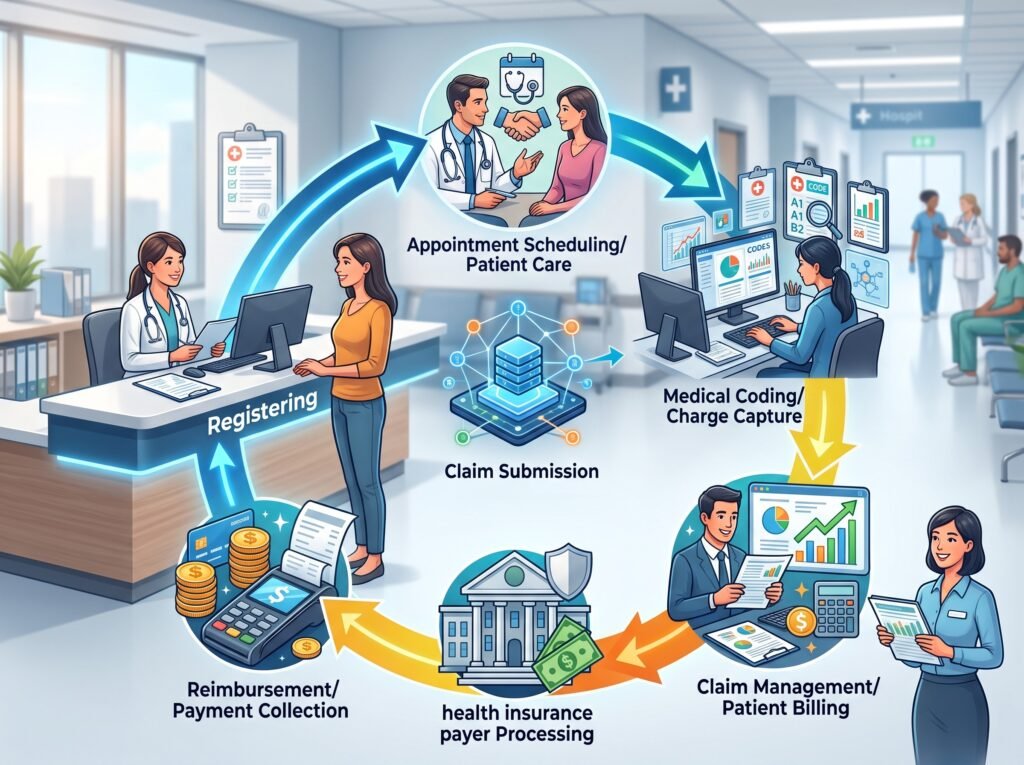
CPT coding plays an important role in the medical billing cycle.
A simplified billing process may include:
- Patient schedules an appointment.
- Patient receives healthcare services.
- Provider documents the encounter.
- Medical coder reviews the documentation.
- Appropriate diagnosis and procedure codes are assigned.
- Claim information is prepared.
- Claim is submitted to the payer.
- Payer reviews the claim.
- Payment, denial, or another payer response is issued.
- Any necessary follow-up or claim correction is completed.
CPT codes therefore connect clinical documentation with administrative and billing processes.
However, CPT coding is only one part of a successful revenue cycle. Accurate patient information, eligibility verification, authorization, diagnosis coding, documentation, payer policies, claim submission, and denial management can also affect reimbursement.
Who Uses CPT Codes?
CPT codes are used across many parts of the healthcare system.
Users can include:
- Physicians
- Qualified healthcare professionals
- Medical coders
- Medical billers
- Hospitals and health systems
- Healthcare organizations
- Insurance companies
- Government healthcare programs
- Healthcare technology companies
- Researchers and analysts
Different organizations may use CPT information for different purposes, including claims processing, reporting, analytics, reimbursement, and healthcare administration.
Tips for Beginners Learning CPT Coding
If you are beginning your medical coding education, focus on understanding the logic behind coding rather than memorizing large numbers of codes.
Helpful habits include:
Learn the major code categories
Understand the general organization of CPT before trying to memorize individual codes.
Read the complete code description
Do not choose a code based solely on a keyword.
Study coding guidelines
Instructions and conventions can significantly affect code selection.
Understand medical terminology
Anatomy, physiology, medical terminology, and common procedures provide an important foundation for coding.
Practice with documentation
Realistic coding exercises can help you learn how documentation supports code selection.
Keep references current
CPT codes and guidelines change. Always use the applicable current code set and authoritative resources.
Know when to ask for clarification
If documentation is unclear, the appropriate process may involve seeking clarification rather than making assumptions.
Frequently Asked Questions About CPT Codes
1. What does CPT stand for?
CPT stands for Current Procedural Terminology. It is a standardized code set used primarily to describe medical services and procedures performed by physicians and other qualified healthcare professionals.
2. How many digits are in a CPT code?
CPT codes are generally five digits. Depending on the CPT category, codes may be numeric or alphanumeric.
3. Are CPT codes the same as diagnosis codes?
No. CPT codes generally describe medical services and procedures, while ICD-10-CM codes generally describe diagnoses, conditions, symptoms, or reasons for healthcare services.
4. What is the difference between CPT and HCPCS?
CPT codes are HCPCS Level I codes. HCPCS Level II is a separate set of codes used primarily for products, supplies, and certain services that are not represented by CPT codes.
5. Who maintains CPT codes?
The American Medical Association maintains the CPT code set through its CPT Editorial Panel and associated processes.
6. Can the same CPT code be used for every insurance company?
Not necessarily. CPT provides a standardized way to report services, but payer policies, coverage rules, documentation requirements, modifiers, reimbursement policies, and other requirements can differ.
7. Why is accurate CPT coding important?
Accurate CPT coding helps communicate what healthcare services were provided and supports appropriate claim processing, reporting, healthcare administration, and data analysis. Coding should always be supported by the medical record and applicable coding rules.
Conclusion
Understanding CPT codes is an essential starting point for anyone learning medical coding and healthcare billing. CPT codes provide a standardized language for describing medical services and procedures, helping providers, coders, payers, and other healthcare organizations communicate consistently.
The key distinction to remember is that CPT coding generally describes what service was performed, while ICD-10-CM coding generally describes the diagnosis or reason for the service. HCPCS Level II codes cover many products, supplies, and services outside the CPT code set.
Because CPT coding rules and code sets are updated regularly, accurate coding requires current references, careful documentation review, and attention to official guidelines. For medical practices and billing teams, combining accurate CPT coding with complete documentation and sound billing processes can support cleaner claims and more reliable healthcare reporting.